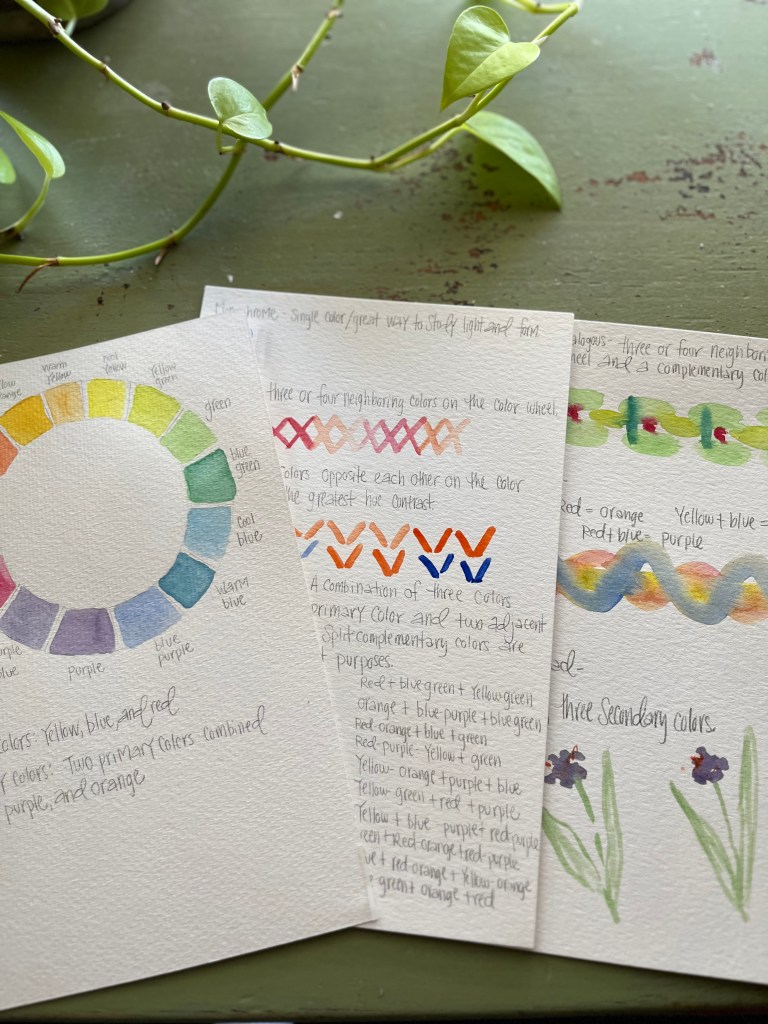
Tomorrow a young friend is coming over to watercolor, and I’m quite excited about it. She needs it for credit for a class in high school, and I hope that this session will not only help her with her coursework but also spark her interest in the world of art and creativity. I’m not sure how much she knows about color theory or if she knows it at all, which makes me a bit nervous, as I want to provide her with a meaningful and enjoyable experience. To ensure we have a productive time, I thought I would paint a color wheel and provide an explanation of primary and secondary colors, as well as how these colors interact with each other in various contexts. We’ll explore different color schemes together, including monochrome, analogous, complementary, split complementary, and complementary analogous, and I’ll encourage her to experiment with creating her own unique color combinations. Additionally, I plan to discuss primary triads and secondary triads, emphasizing how they can be used to create balance and harmony in artwork. I’m looking forward to an engaging and educational experience for both of us, where we can share ideas and learn from each other. I have only taught one watercolor class, but I didn’t add in color theory due to the basic focus of that lesson. Now that I am a little more experienced and understand how vital color theory is for beginners, I feel it necessary to incorporate this foundational knowledge into a lesson so the student better understands how to mix colors effectively and express their vision on paper. Through this creative journey, I hope to inspire her and help her develop her artistic voice as she navigates the world of watercolor.

 Sevenfreckles
Leave a comment